


20th INTERNATIONAL p53 WORKSHOP
PROGRAM
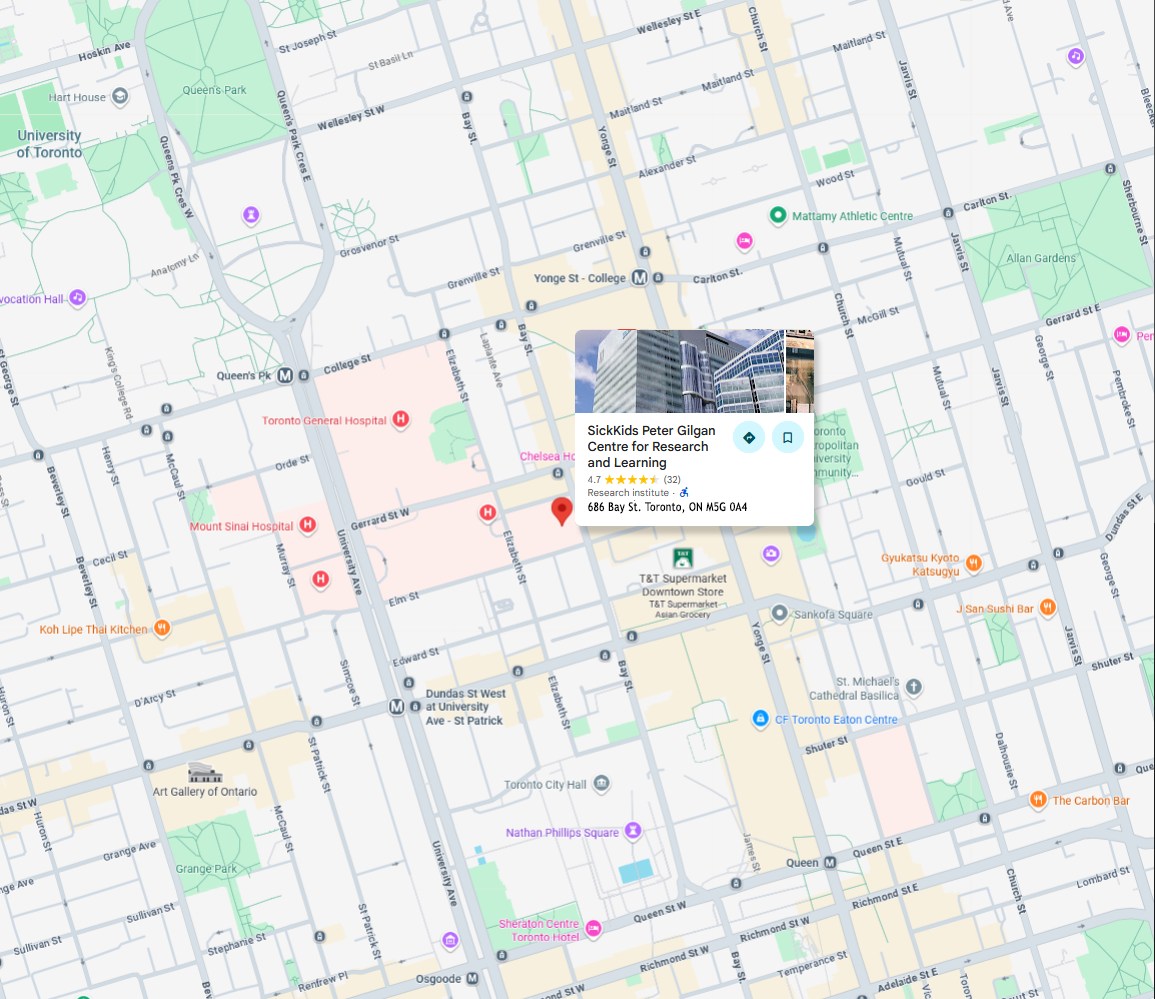
SickKids Peter Gilgan Centre for Research and Learning, 686 Bay St., Toronto, ON
April 27 – May 1, 2026
Rooms: Gallery, Event Rooms 2a/2b (Second Floor), and Event Rooms 3a/3b (Third Floor)
Registration: 7:00 am to 5:00 pm, April 28 – 30
(updated: 2026-04-22)
(updated: 2026-04-22)
| Monday, April 27, 2026 | ||
| 3:00 – 6:00 pm | Early Registration | 1st Floor lobby Patient Support Centre Hospital for Sick Children 175 Elizabeth St.  |
| 6:00 – 9:00 | Welcome Reception ★ | 22nd Floor Patient Support Centre Hospital for Sick Children 175 Elizabeth St. |
| Tuesday, April 28, 2026 | ||
| 7:00 – 8:30 | Sign in and Breakfast | PGRL Gallery |
| 8:30 – 9:15 | Introductory remarks and welcome | Org Committee Chairs + Chiefs of Research (SK, UHN, MSH) |
| Session 1: A tribute to Pierre Hainaut 9:15 – 11:15 – Moderator: David Malkin |
Main Auditorium | |
| Emilie Montellier | Determinants of Phenotypic Variability in the Li-Fraumeni Syndrome. | University of Grenoble Alpes |
| Arnold Levine | The role of the Diversity box and the P2 promoter in Associative Memory of gene expression. | Institute for Advanced Studies, Princeton |
| Christian Kratz | Research Update from the Li-Fraumeni Syndrome Registry in Germany. | University of Hannover |
| David Malkin | Exploring the complex relationship of p53 and Li-Fraumeni Syndrome: Translating Discovery Science into the Clinic. | The Hospital for Sick Children |
| Session 2: Presentations from Proffered Abstracts I 11:15 – 11:45 – Moderator: Daniel Schramek |
Main Auditorium | |
| 11:45 – 1:00 | Lunch | PGRL Gallery |
| Session 3: p53 and the Dark Genome 1:00 – 3:15 – Moderator: Benjamin Greenbaum |
Main Auditorium | |
| Kathleen Burns | Transposable elements and tumor suppressor genes. | Dana-Farber Cancer Institute |
| John Abrams | p53 Biology Meets Jumping Genes. | UT Southwester Medical Center |
| Andrei Gudkov | p53 and inflammation. | Roswell Park Comprehensive Cancer Center |
| Martin Fischer | Genome regulation by p53. | Otto von Guericke University |
| Raul Rabadan | Illuminating the Dark Cancer Genome using Foundation Models. | Columbia University |
| 3:15 – 3:45 | Break | PGRL Gallery |
| Session 4: p53 and Cancer Evolution 3:45 – 5:30 – Moderator: David Lane |
Main Auditorium | |
| Gigi Lozano | Mutant p53 proteins in tumor evolution and dissemination. | MD Anderson Cancer Center |
| Benjamin Greenbaum | Evolutionary and immune trade-offs yield vulnerabilities for p53. | Memorial Sloan Kettering Cancer Center |
| Giannino Del Sal | Mutant p53 and the Mechanics of Tumor Adaptation: Metabolic, Nuclear, and Immune Interfaces. | University of Trieste, ICGEB, and IFOM |
| Fritz Vollrath | Elephants in our Room. | Oxford University |
| END OF DAY 1 | ||
| Wednesday, April 29, 2026 | ||
| 7:00 – 8:00 | Breakfast | PGRL Gallery |
| Session 5: Targeting p53 8:00 – 10:15 – Moderator: Klas Wiman |
Main Auditorium | |
| Kanaga Sabapathy | p53 as a target for cancer prevention and therapy. | Nanyang Technological University |
| Galina Selivanova | p53, inflammation and microbiome. | Karolinska Institute |
| Maureen Murphy | Making a dumb protein smart: PADI4 citrullinates p53 to enhance tumor suppression. | The Wistar Institute |
| Andreas Strasser | Which attributes of mutant p53 proteins should be targeted for cancer therapy? | Walter and Eliza Hall Institute of Medical Research |
| Shelley Berger | Epigenetic pathways as targets in human cancer. | Unniversity of Pennsylvania |
| 10:15 – 10:45 | Break | PGRL Gallery |
| Session 6: p53 Interception and prevention 10:45 – 12:30 – Moderator: Moshe Oren |
Main Auditorium | |
| Bowen Li | Development of programmable mRNA nanomedicines for precision cancer immunotherapy. | University of Toronto |
| Jason Berman | Zebrafish Models: Illuminating Cancer Prevention Pathways in p53-Mediated Tumors. | University of Ottawa |
| Klas Wiman | Novel strategies for targeting missense and nonsense mutant TP53 in cancer. | Karolinska Institute |
| Sarah Blagden | Learning from LungVax, is now the time for LFS-Vax? | Oxford University |
| Session 7: Presentations from Proffered Abstracts II 12:30 – 1:00 – Moderator: David Kirsch |
Main Auditorium | |
| 1:00 – 2:00 | Lunch | PGRL Gallery |
| 👉 POSTER SESSION #1 2:00 – 3:30 |
PGRL Gallery + outside event rooms 2a/2b | |
| Session 8: p53, Apoptosis and DNA Damage 3:30 – 4:00 – Moderator: David Kirsch |
Main Auditorium | |
| Rieko Ohki | Extrinsic induction of apoptosis and tumor suppression via the p53- Reprimo-Hippo-YAP-p73 pathway. | National Cancer Center Research Institute, Tokyo |
| Tomoo Iwakuma | Tailored combination of ROS and DDR targeting exploits p53 deficiency for synthetic lethality. | Children’s Mercy Hospital and Clinics |
| Session 9: p53, Immunity and Autoimmunity 4:00 – 6:00 – Moderator: Batsheva Kerem |
Main Auditorium | |
| Xin Lu | P53, EBV and p53 autoantibodies. | Oxford University |
| David Lane | Regulation of the p53 pathway by CDK inhibition, splicing and transcription. | Karolinska Institute |
| Moshe Oren | p53 regulates histone modifications to promote mature luminal identity . | Weizmann Institute of Science |
| Scott Lowe | Mimicking p53 for cancer therapy. | Memorial Sloan-Kettering Cancer Center |
| Uri Tabori | The role of TP53 mutations in tumor initiation, progression and immune response of replication repair deficient cancers. | The Hospital for Sick Children |
| END OF DAY 2 | ||
| Dinner at Hockey Hall of Fame ★ – 30 Yonge St. Toronto, ON – Guest Arrival Time: 6:30 pm |
||
| Thursday, April 30, 2026 | ||
| Scenic Toronto Morning Run/Walk ★ – Meetup at PGRL Centre – 686 Bay St., Toronto, ON – Meet-Up Time: 7:00 am |
||
| 7:00 – 8:30 | Breakfast | PGRL Gallery |
| Session 10: p53 Structure and Function (Wildtype and Mutant) 8:30 – 10:15 – Moderator: Guillerima Lozano |
Main Auditorium | |
| Carol Prives + Jill Bargonetti (Keynote talk) | Structural and functional studies of wild-type and mutant p53 proteins. | Columbia University |
| Ran Kafri | Preventing the onset of cancers in Li Fraumeni Syndrome. | The Hospital for Sick Children |
| Jim Manfredi | Transcriptional regulation by wild-type and mutant p53. | Mount Sinai School of Medicine |
| Wei Gu | Understanding the complexity of p53-mediated activities in tumor suppression. | Columbia University |
| 10:15 – 10:45 | Break | PGRL Gallery |
| Session 11: Presentations from Proffered Abstracts III 10:45 – 11:15 – Moderator: Laura Attardi |
Main Auditorium | |
| Session 12: p53 and Cell Cycle Disruption 11:15 – 1:15 – Moderator: Daniel Schramek |
Main Auditorium | |
| Andrei Budanov | Sestrins in the regulation of different types of cell death. | Trinity College Dublin |
| Francis Barr | Integrating mitotic checkpoint activation with p53-dependent cell cycle arrest. | Oxford University |
| Galit Lahav | p53 Dynamics and Decision Making in Single Cells. | Harvard University |
| Karen Oegma | The mitotic stopwatch intersects with basal p53 activation to control cell proliferation. | University of California- San Diego |
| Andreas Joerger | Targeting the p53 cancer mutome: from Y220C to pan-TS mutant reactivators. | Goethe University Frankfurt |
| Volker Dötsch | DARPins for stabilization or degradation of p53 mutants. | Goethe University Frankfurt |
| 1:15-2:00 | Lunch | PGRL Gallery |
| 👉 POSTER SESSION #2 2:00 – 3:30 |
PGRL Gallery + outside event rooms 2a/2b | |
| Session 13: p53 and Genomic Instability 3:30 – 6:00 – Moderator: Giannino Del Sal |
Main Auditorium | |
| Batsheva Kerem | Hypertranscription caused by P53 deficiency triggers nucleotide insufficiency that induces replication stress and genomic instability. | Hebrew University |
| Daniel Schramek | Systematic identification of novel intrinsic and extrinsic regulators of wild-type and mutant p53 stability. | Lunenfeld-Tanenbaum Research Institute, Mount Sinai Hospital |
| Laura Attardi | Deciphering how p53 governs cell state transitions in cancer and injury repair. | Stanford University |
| David Kirsch | p53 regulates metabolism to maintain chromosomal stability. | Princess Margaret Cancer Centre |
| Gerry Melino | p53 does not work alone: interaction with ZNF750, ZNF148 and WWOX. | University of Tor Vergata |
| Luis Martinez | The cGAS/STING pathway bolsters p53 for tumor suppression. | Stony Brook University |
| END OF DAY 3 | ||
| Trainee Social ★ – TIFF LIGHTBOX, Malaparte Lounge (6th Floor) – 350 King St. W, Toronto, ON – Guest Arrival Time: 6:30 pm |
||
| Faculty Speaker Dinner ★ – Jazz Bistro – 251 Victoria St., Toronto, ON – Guest Arrival Time: 6:30 pm |
||
| Friday, May 1, 2026 | ||
| 7:00 – 8:30 | Breakfast | PGRL Gallery |
| Session 14: p53 Partners and Interactors 8:30 – 10:45 – Moderator: Jim Manfredi |
Main Auditorium | |
| Vinod Balachandran | RNA vaccines for Pancreatic cancer. | Memorial Sloan-Kettering Cancer Center |
| Trevor Pugh | Cell-free DNA for early detection of cancer and immune responses in Li-Fraumeni Syndrome. | Princess Margaret Cancer Centre, Ontario Institute for Cancer Research |
| Jean-Christophe Bourdon | What is p53? A Discussion Comparing the Single-Protein Model and the Multi-Isoform Model. | The University of Dundee |
| Tomer Cooks | Out of the cell: extracellular p53-based interactions. | Ben-Gurion University |
| Giovanni Blandino | TP53 mutations and cancer resistance. | Regina Elena National Cancer Institute |
| 10:45 – 11:15 | Break | PGRL Gallery |
| Session 15: p53 and MDM2 11:15 – 12:05 – 1Moderator: Arnold Levine |
Main Auditorium | |
| Christine Eischen | Bi-functional MDM2 degrader increases efficacy against mutant p53 cancer. | Thomas Jefferson University |
| Matthias Dobbelstein | Regulator and effector of p53 – the expanding role of MDM2. | University Medical Center Göttingen |
| Session 16: p53 in the clinic 12:05 – 1:20 – Moderator: David Malkin |
Main Auditorium | |
| Kara Maxwell | P53 hypomorphs - from biology to clinical practice in adults. | University of Pennsylvania |
| Judy Garber | Clinical Updates from the LiFT UP Project. | Dana-Farber Cancer Institute |
| Masha Poyurovsky | Functional Restoration of p53 Y220C: PYNNACLE Phase 2 Clinical Data Update and Expanding the Therapeutic Landscape with Rezatapopt. | PMV Pharma |
| POSTER AWARDS CEREMONY AND CLOSING REMARKS (1:20 – 1:50) |
||